

Description
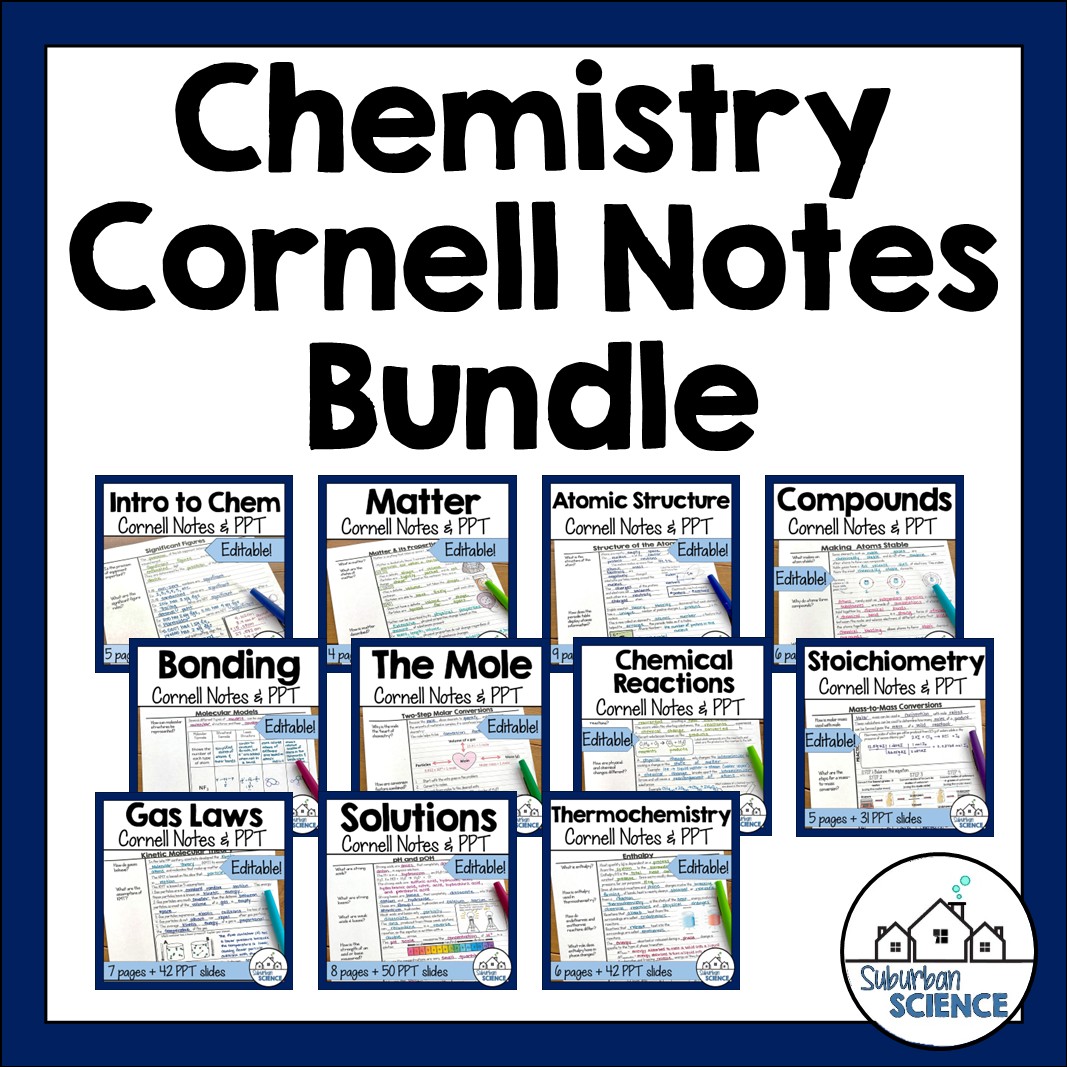
Want your high school students to have better note-taking skills? These Chemistry Cornell notes are a great training tool for your students and can be added to an interactive notebook or binder. Each of these note pages corresponds with a PowerPoint to provide a thorough introduction to all the topics in a traditional Chemistry course.
NOTE: These note pages and PowerPoints are also included in my Full-Year Chemistry Curriculum.
What’s included:
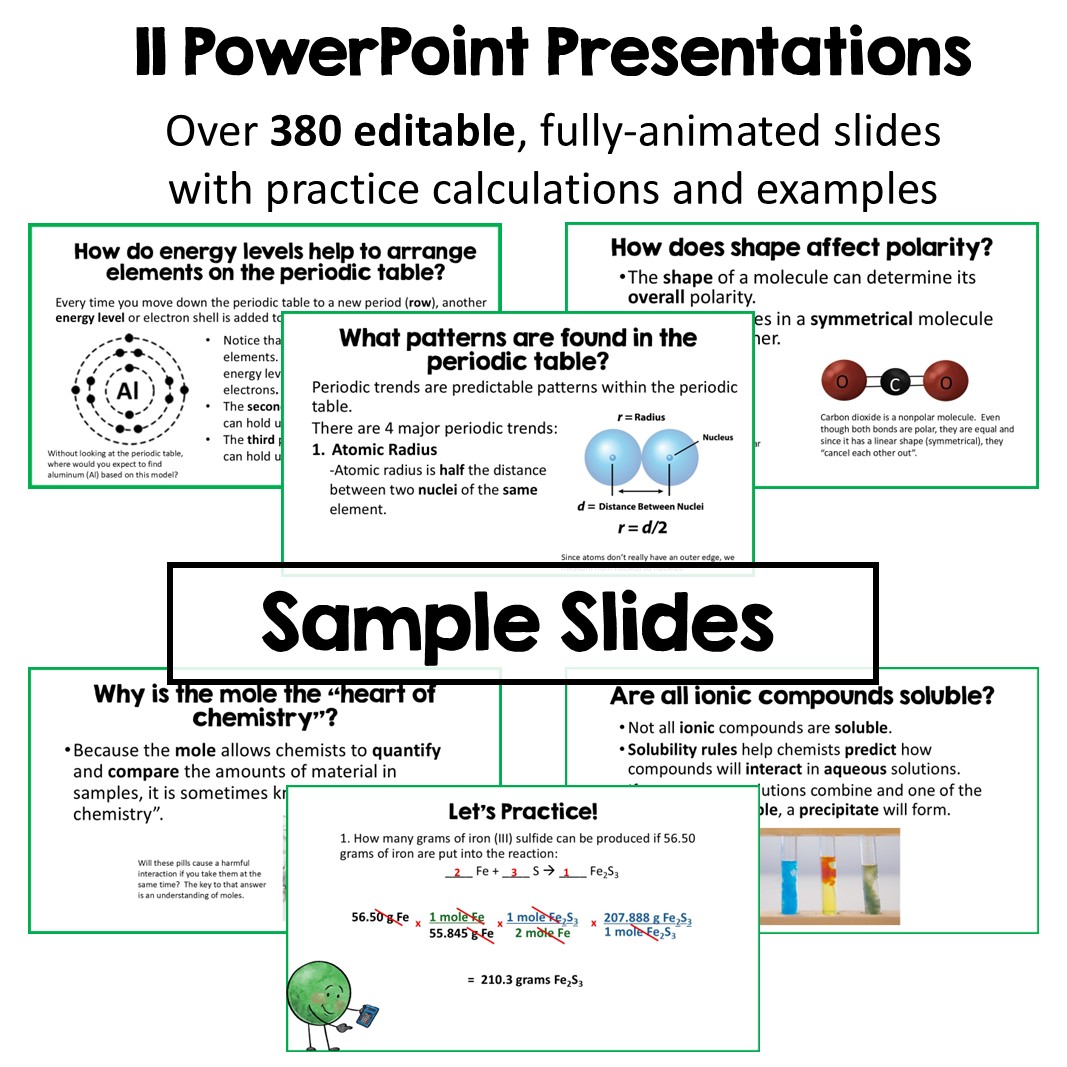
- 11 EDITABLE PowerPoints (380 slides total)
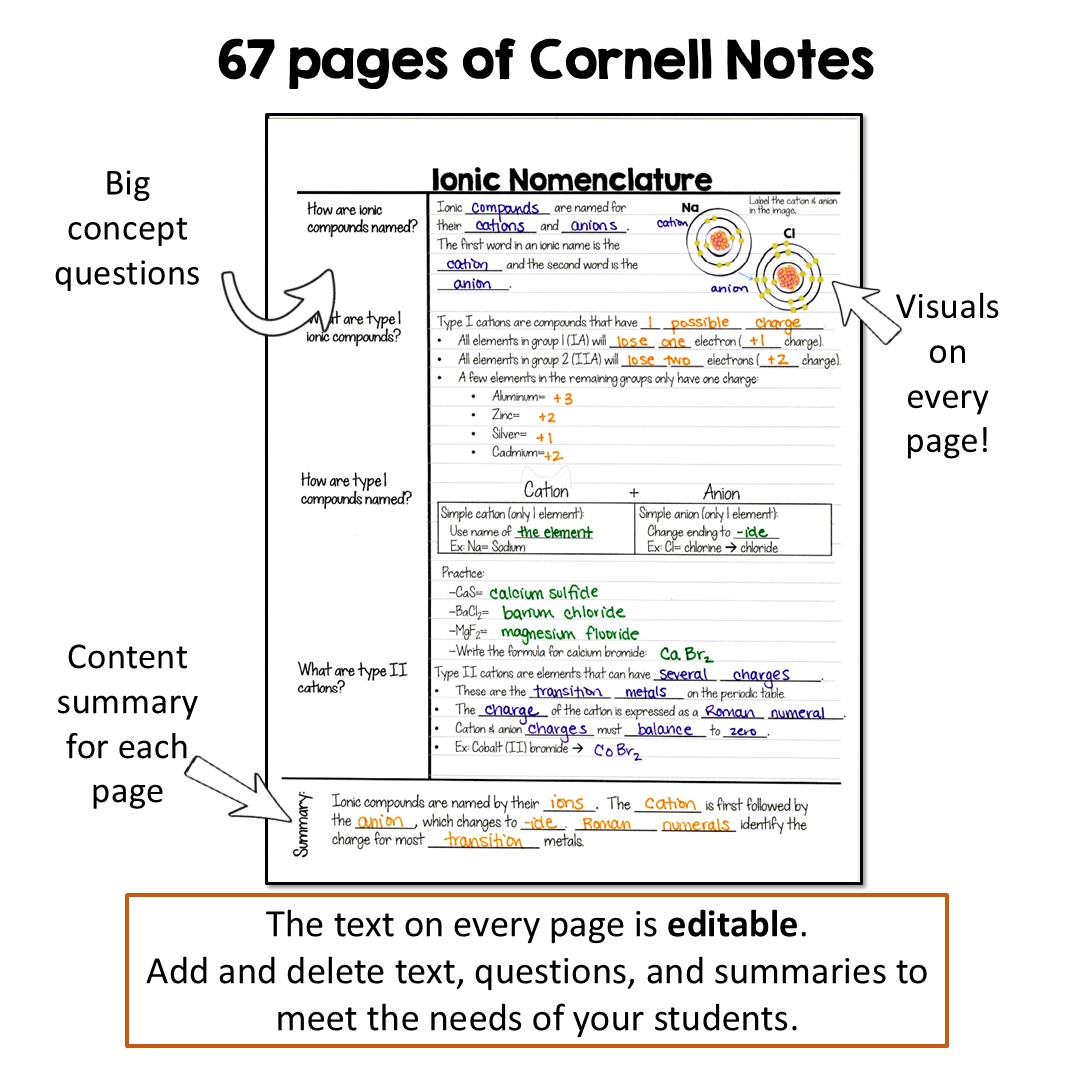
- 67 EDITABLE Cornell Note pages to make differentiation easy!
-Every note page comes in 4 versions:
- Quick Print– fill-in-the-blank guided notes (PDF)
- Keys- completed fill-in-the-blank guided notes (PDF)
- Editable version– all text can be edited or removed (PPTX)
- Digital version– editable text for 1:1 classrooms & virtual learners (Google Slides)
Slides include example calculations and practice problems as well as textual definitions and explanations.
➤How can I edit these resources?
The text on the PowerPoints and Cornell Notes is all editable so you can adjust the level of content and wording. This allows you to change the font, add or remove content, and eliminate blanks for a note-taking experience that changes with the level of your students. Most images included in the PowerPoints and note pages are NOT editable to comply with the restrictions provided by the illustrators whose images I’ve purchased for use in this resource.
➤Why are these notes considered “error-proof”?
The PowerPoint slides have bold words that match exactly with the blanks on the Cornell notes pages. This makes it easy for students to follow. As students get more experienced with note-taking, you can eliminate the fill-in-the-blank portions of the Cornell notes, allowing for more independence.
➤What topics are included?
- Intro to Chemistry (dimensional analysis, measurement, sig figs)
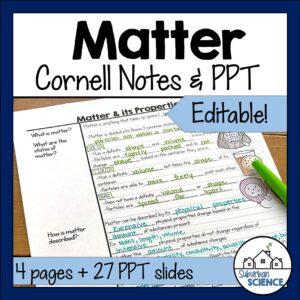
- Matter (properties of matter, conservation of mass)
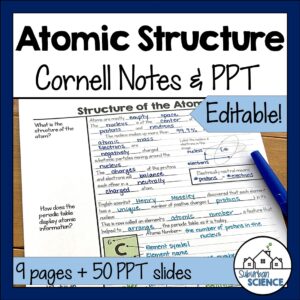
- Atomic Structure (evolution of atomic theory, subatomic particles, electron configuration)
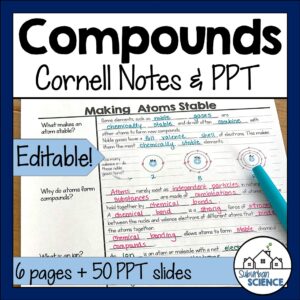
- Compounds (organization of the periodic table, writing and naming ionic and covalent compounds)
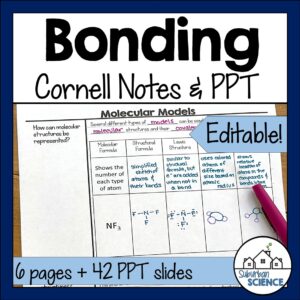
- Bonding (polarity, multiple bonds, molecular geometry & VSEPR)
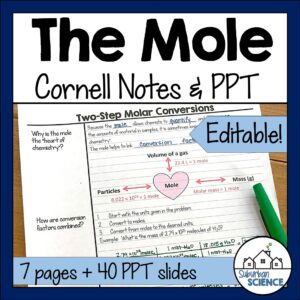
- The Mole (simple molar conversions, empirical & molecular formulas)
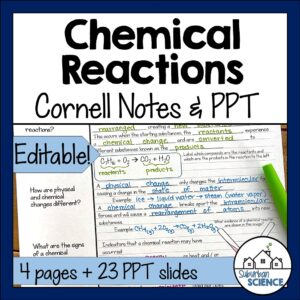
- Chemical Reactions (balancing equations, types of chemical reactions)
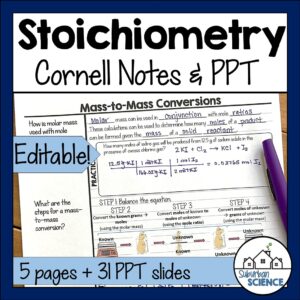
- Stoichiometry (mole ratios with chemical equations, limiting reactants)
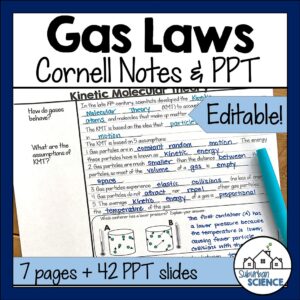
- Gas Laws (kinetic molecular theory, simple gas laws, ideal gas law)
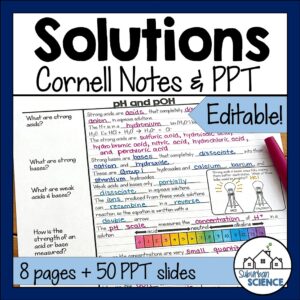
- Solutions (molarity, colligative properties, solubility, acids and bases)
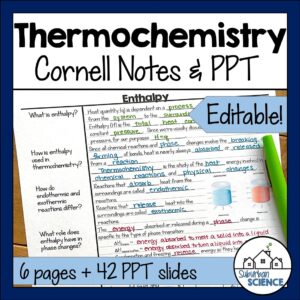
- Thermochemistry (specific heat, enthalpy, entropy, collision theory)
For more details on the topics included, please click on the preview here.
__________________________________________________________________
What are Cornell notes?
Cornell notes consist of 1 page separated into 3 sections. A left-hand column provides major ideas and essential questions, while the large right-hand section is for detailed notes. A third section is found at the bottom of the page for summarizing the notes.
Why should you use the Cornell note-taking method?
Cornell notes are organized and efficient. They help students easily pick out the important ideas for any topic. They also make studying easier because students can use the left column of questions as a self-quiz.
__________________________________________________________________
⭐ I value your feedback. Please rate this product.



Reviews
There are no reviews yet.